
Online ordering apps in Kenya: how to take orders yourself
There are two different questions hiding inside this search. One is which app to install. The other is how to take orders without one, which is the harder and more useful answer.
Home / Blog / Restaurant ordering software: moving regulars off the delivery apps
Regulars do not leave a delivery app out of loyalty to you. They leave when ordering from you is easier and the stamp card is theirs. Here is how to make both true.
Anzul Aqeel · Founder & Director, Anunzio International FZC · 7 October 2026 · updated 16 October 2026
You move regulars off the delivery apps one order at a time, with a reason that is personal to them: a stamp card, a first-order offer, a direct service that tells them every step. GetMenu's restaurant ordering software gives you the page, the WhatsApp messages, the loyalty card in Apple Wallet and Google Wallet, and the reminders that bring the next order.
Regulars stay on the apps out of habit, not loyalty to the app. The app is already on their phone, their address is saved, and they know what the order will cost.
They do switch, and the surveys say why. NCR Voyix's 2025 report found that 58% of customers prefer to order delivery through a restaurant's own app or website, and 36% named loyalty points as a reason. The incentive has to be personal: a card that fills up with their stamps, an offer only they get, a message from the restaurant itself.
The reason you want them to switch is simpler. One fee guide puts third-party delivery commission at 15 to 30% per order on both Uber Eats and DoorDash, before processing fees and paid promotions. A regular who orders twice a month on your own page keeps that money in the kitchen.
The app's advantage is that it remembers the customer. Your page has to remember them too, and then add things the apps do not give you: a card that is theirs, offers only you make, and a message from your own number.
GetMenu does the remembering on the customer's own phone. Their name, WhatsApp number, building and unit number fill in by themselves the second time they order, because the page keeps them in that phone's browser rather than looking them up in our database. The link lives in your WhatsApp chat with them, so the next order is one tap away. The confirmation comes from your own number the moment the order is placed, with a link to follow the order.
Then come the things the app cannot copy, on the Growth and Pro plans. A first-order welcome offer and an every-Nth-order reward run by themselves. Bundles sell any three dishes from a list you choose for one price. A secret menu sits behind an unlock code you give only to regulars.
Regulars find your own ordering page in three places: your WhatsApp chat with them, a printed card in the bag, and the receipt.
GetMenu generates a QR code for your page, its QR designer dresses it in your colours, and a print pack is emailed to you, ready for the printer. Put a card in every bag that leaves through a delivery app, with one sentence: order direct next time and the stamps are yours. If you sell at the counter with the GetMenu POS, switch on the receipt's QR code, so a walk-in customer takes your page home with the bill.
After a direct order the customer has your number and the link. Every status update comes from that number: confirmed, on its way with the rider's name, delivered.
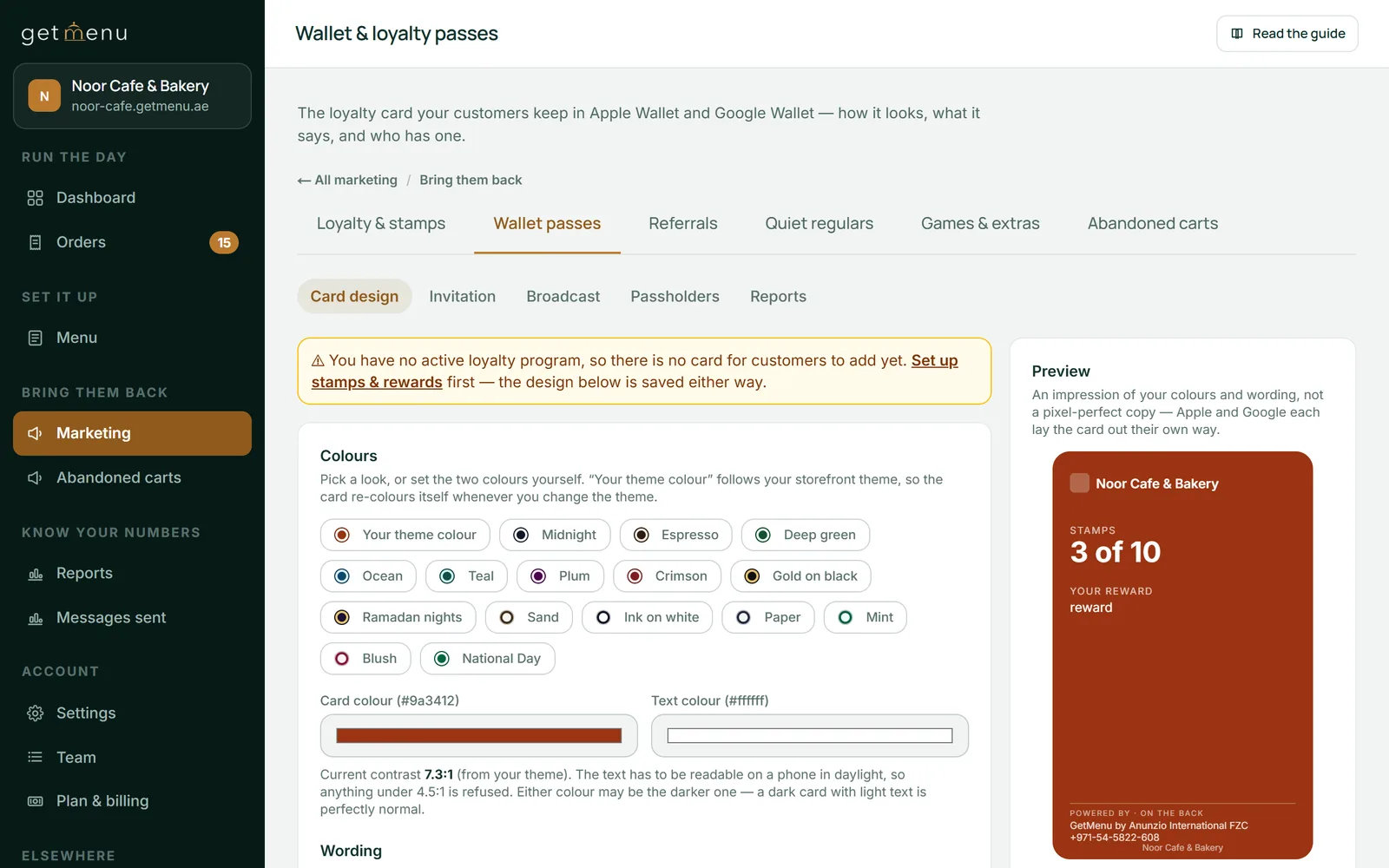
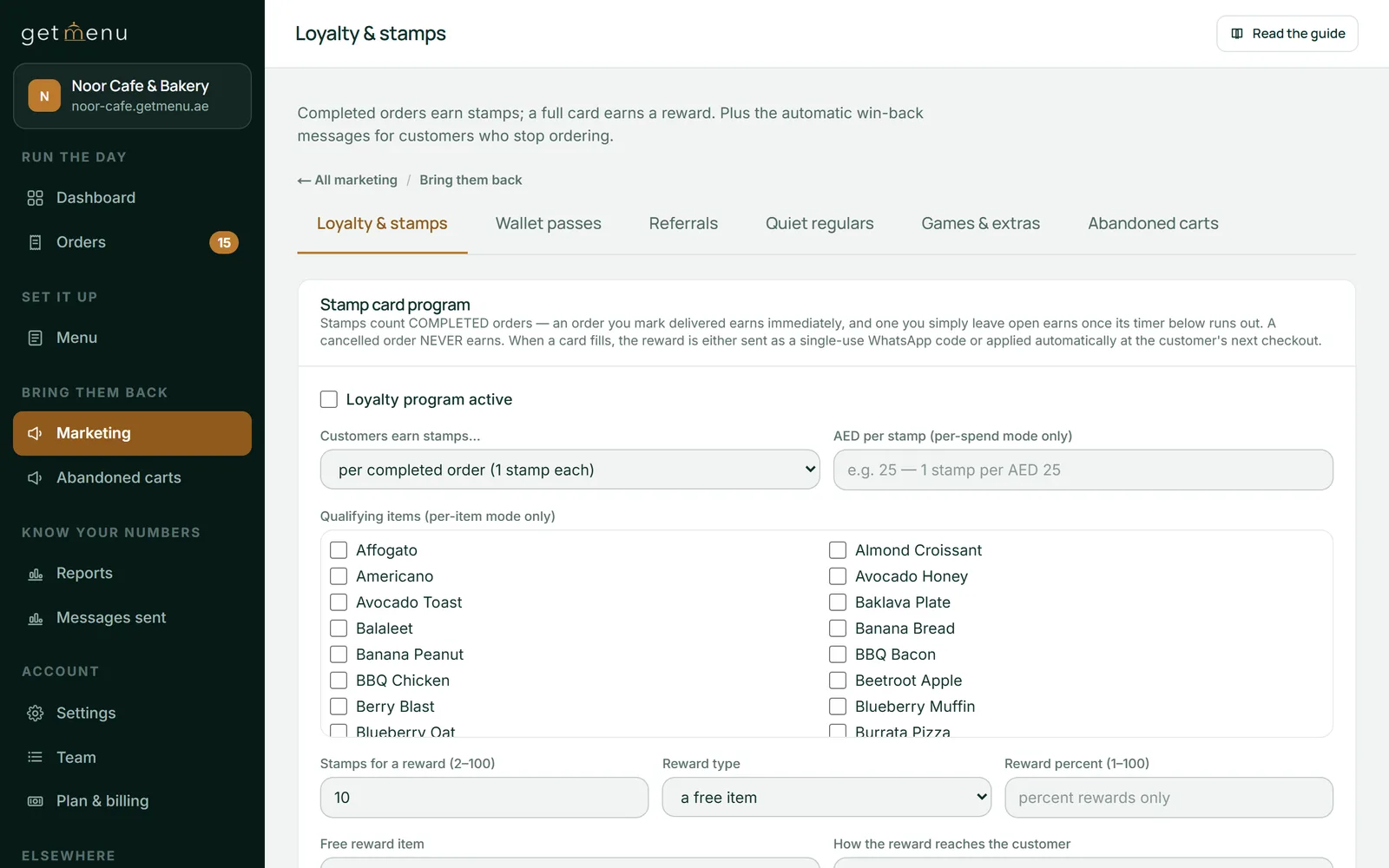
A stamp card works when the customer never has to look for it, which is why GetMenu puts it in Apple Wallet and Google Wallet with no app to install. Stamp cards, loyalty tiers and the wallet card come with the Pro plan. Stamps can be earned per order, per amount spent, or only on the dish you want to sell more of.
The card updates itself after every stamp and shows the reward when one is waiting. The reward can be a code or an automatic discount at checkout. Regulars grow into tiers, each with its own automatic discount. A stamp counts when the order is complete, never for a cancelled order, and a phone number given at the counter earns the same stamp.
Olo's analysis of more than 100 million guest records found that 60% of restaurant revenue comes from repeat guests, and SevenRooms' trends research puts repeat diners at 27% more spend than first-time diners. Wallet cards also get added where apps do not get installed: one loyalty vendor's guide puts adoption at 65 to 75% for wallet passes against 10 to 20% for standalone apps, without naming a study. Adding a pass takes one tap.
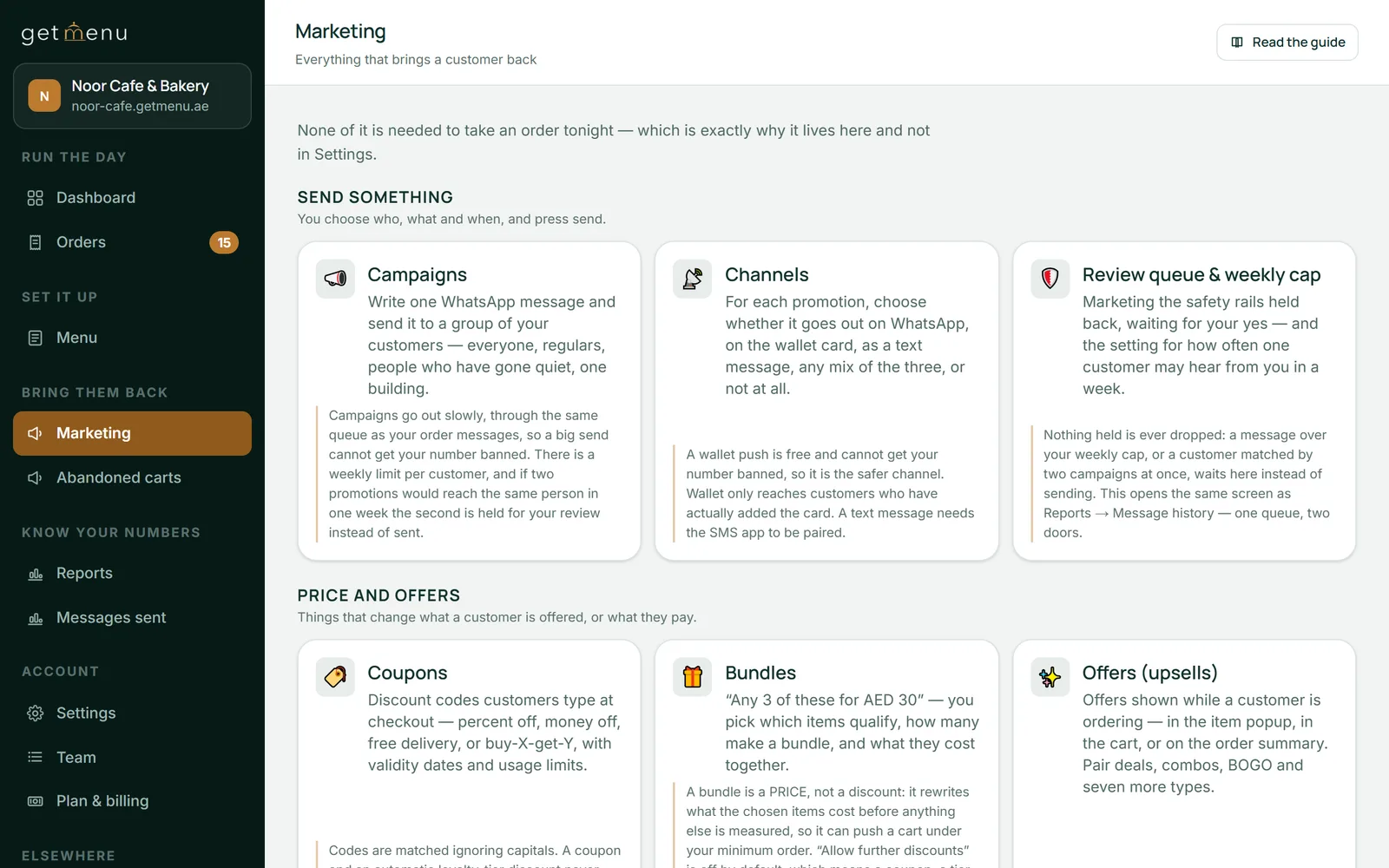
The second direct order forms the habit, and reminders earn it without a marketing team. After a delivered order, GetMenu sends a "Hungry again?" reminder at each customer's usual mealtime, with an optional coupon on the Growth and Pro plans.
The first-order offer brings the first direct order. You set it once, for example a dish at a special price, and every new customer gets it on their first order from your page. It is on the Growth and Pro plans.
A customer who has not ordered for 14, 30 or 60 days gets a message asking them back, and you can attach a coupon. Each customer gets only the newest message that is due. If a regular starts ordering less often than usual, GetMenu reminds them earlier. After a delivered order the customer gets a thank-you with your Google review link, and a referral link gives both sides a coupon when the friend's first order is delivered. Read more about customer retention and reordering.
The mealtime reminder comes with every plan. Quiet-regular messages and referrals are on Growth and Pro, and the win-back messages are on Pro.
Automatic marketing has limits. Win-backs, quiet-regular nudges and referral coupons obey a weekly limit per customer, 2 by default, go out only between 10:00 and 21:00 in your time zone, and anything over the limit waits for your approval. Order messages are sent separately from promotions, so a promotion does not hold up an order confirmation.
Keep the apps. New customers find you there. Your own online ordering and delivery system runs beside them and takes the regulars. Our guide to online food delivery platforms compares the apps themselves.
Online and WhatsApp orders show on the POS screen next to counter sales. Once each app gives you partner access, orders from the delivery apps can land on the same orders board and kitchen screen as your own. App orders keep the app's total and stay out of your cash count. The POS and the kitchen screen come with the yearly POS add-on.
A food delivery ordering system of your own also solves the address problem. At checkout the customer picks their building from your list, types the unit number and can share a map pin. The riders' WhatsApp group gets the dispatch with the pin, the phone number and whether to collect cash or bring the card machine.
The best restaurant online ordering software for this job is one your regulars reach in one tap and never install. Most online food ordering solutions stop at the order, but the switch happens after it.
So check five things in any food ordering software for restaurants. Can the page move to your own domain? Does it remember the customer without asking them to make an account? Does the confirmation come from your own WhatsApp number? Is the loyalty card in Apple Wallet and Google Wallet? And do reminders run by themselves, with a limit per customer?
GetMenu answers yes to all five: your own domain is an add-on the GetMenu team connects for you, the wallet card is on the Pro plan, and the weekly limit is on Growth and Pro. There is no commission on orders from your own page, and the plans are on the pricing page in your currency. The trial runs 15 days and needs no card.
Anzul Aqeel, the founder of GetMenu, puts it this way: "Nobody leaves an app for your sake. They leave because ordering from you got easier than ordering from the app, and because the stamp card is theirs."
Habit and saved details. The app is already on their phone, it remembers their address and card, and one app covers many restaurants. Surveys show most customers would rather order direct, if your own page is just as easy and gives them something the app cannot.
Think in orders, not weeks. The first direct order needs a reason, such as the QR card in the bag and a welcome offer. The second, prompted by a reminder at their usual mealtime, forms the habit. Count it per customer: a regular who has ordered direct twice is the one to reward.
Put a QR card in every app bag, send the link in WhatsApp, and offer a stamp card that only direct orders fill. Make the first direct order cheap with a welcome offer, then let the reminder do the rest: a "Hungry again?" message at their usual mealtime. Stamp cards are on the Pro plan, and welcome offers are on Growth and Pro.
No. The apps bring new customers who have never heard of you, and that is worth paying for once. The mistake is paying commission on the fifth order from the same regular. Keep the apps for discovery, move the repeat orders to your own page, and once each app gives you partner access, let both land on one orders board so the kitchen sees one list.
A reward they can see coming. Show how many stamps earn a free dish at the moment they add it, and make adding it one tap from the ordering page or the WhatsApp message. The card in Apple Wallet or Google Wallet then updates itself after every stamp and shows when a reward is waiting, so it earns its place on the phone. The wallet card is on the Pro plan.
You do not need an app. A web page on your own address does the ordering, WhatsApp carries the confirmation and the rider dispatch, and the loyalty card sits in the wallet the customer already has. GetMenu takes no commission on orders from your own page, the plans are on the pricing page in your currency, and the 15-day trial needs no card, so the cost is known before the first order.
There are two different questions hiding inside this search. One is which app to install. The other is how to take orders without one, which is the harder and more useful answer.
The useful question is not whether to join a delivery app. It is which parts of your business you are happy for somebody else to own, and which parts you are not.