
Android restaurant POS: tablets, phones and POS machines that work
Android lets a small restaurant run its counter on a tablet it already has, or on a machine with the printer inside. Here is which devices to buy and how to set them up.
Home / Blog / Petpooja POS for restaurants outside India
Petpooja is a large Indian billing system, and most of its searches come from India. A restaurant in the Gulf or beyond should check four things before choosing it, and this guide walks through each.
Anzul Aqeel · Founder & Director, Anunzio International FZC · 7 October 2026 · updated 16 October 2026
Petpooja POS is a strong billing system for Indian restaurants, with one of the best Swiggy and Zomato links in India. Outside India, check four things: local support, which delivery apps connect, how orders reach your riders and the full yearly price. For direct delivery with your own riders, GetMenu is built for that.
Petpooja is a restaurant billing POS and management platform from Ahmedabad, built around fast billing, kitchen order tickets, inventory and the Indian delivery apps. Its own site says it runs more than 150,000 businesses across India, the UAE and South Africa, with billing, payroll, inventory and operations software. The searches tell the same story. Petpooja billing is searched about 50 times a month in the UAE against tens of thousands worldwide, most of them in India, where the petpooja software grew up.
It has crossed borders on purpose. Hotelier India reported in 2022 the expansion into the UAE with eLine Hospitality and into South Africa with Zestro. The company was aiming for a UAE team of ten and more than 500 outlets. Its UAE page now says more than 500 restaurants across the UAE use it. Users rate it well: one aggregator gives it 94% user satisfaction. The question for a restaurant in Dubai, Riyadh or Kuala Lumpur is narrower: does the system that works so well in India work the same way here?
In India, Petpooja sells directly and through a reseller programme. It entered the UAE and South Africa through local partners, eLine Hospitality and Zestro, whose teams took on sales and support. Its UAE page now offers its own support by call or email. That can be perfectly good, but ask before you sign, not after. Ask who installs the petpooja pos machine and the printers, who answers at nine on a Friday night, and whether a partner or Petpooja holds the contract.
Petpooja's site also has pages for Singapore and Malaysia. In a country it does not list, plan for remote support, or look at a system built to run from a browser anywhere. GetMenu runs from a web browser, and the POS app runs on iPad, iPhone and Android, in any country. The restaurant's own currency and country are set at signup, and restaurants outside the UAE already run on it.
This strength changes from country to country. The reviews single out Petpooja's Swiggy and Zomato integration as among the best in India, and for an Indian restaurant that is half the value of the petpooja pos software. In the Gulf, customers order on Talabat, Deliveroo, Careem, Keeta and noon Food, and in Malaysia on GrabFood and foodpanda. Petpooja's UAE page says orders from Talabat, Deliveroo, Careem and noon land on one POS screen. Elsewhere, ask exactly which apps are connected in your city today, with a live restaurant you can call.
GetMenu's list is the Gulf and Asian one. Once each app gives you partner access, orders from Talabat, foodpanda, Deliveroo, Careem, Keeta and GrabFood land on the same orders board and kitchen screen as your own, and print on the same kitchen ticket. Noon Food orders are typed in by hand. Marking a dish sold out tells the connected apps for dishes you have matched.
A restaurant billing system prints the bill. Both work well as POS billing software for restaurant counters, so the difference is what happens after the bill: how the kitchen sees the order, how the rider gets the address, and what the customer is told. In the US, DoorDash and Uber Eats charge 15 to 30% of every order for doing that part. That is why direct delivery, orders from your own page carried by your own riders, is the thing worth getting right.
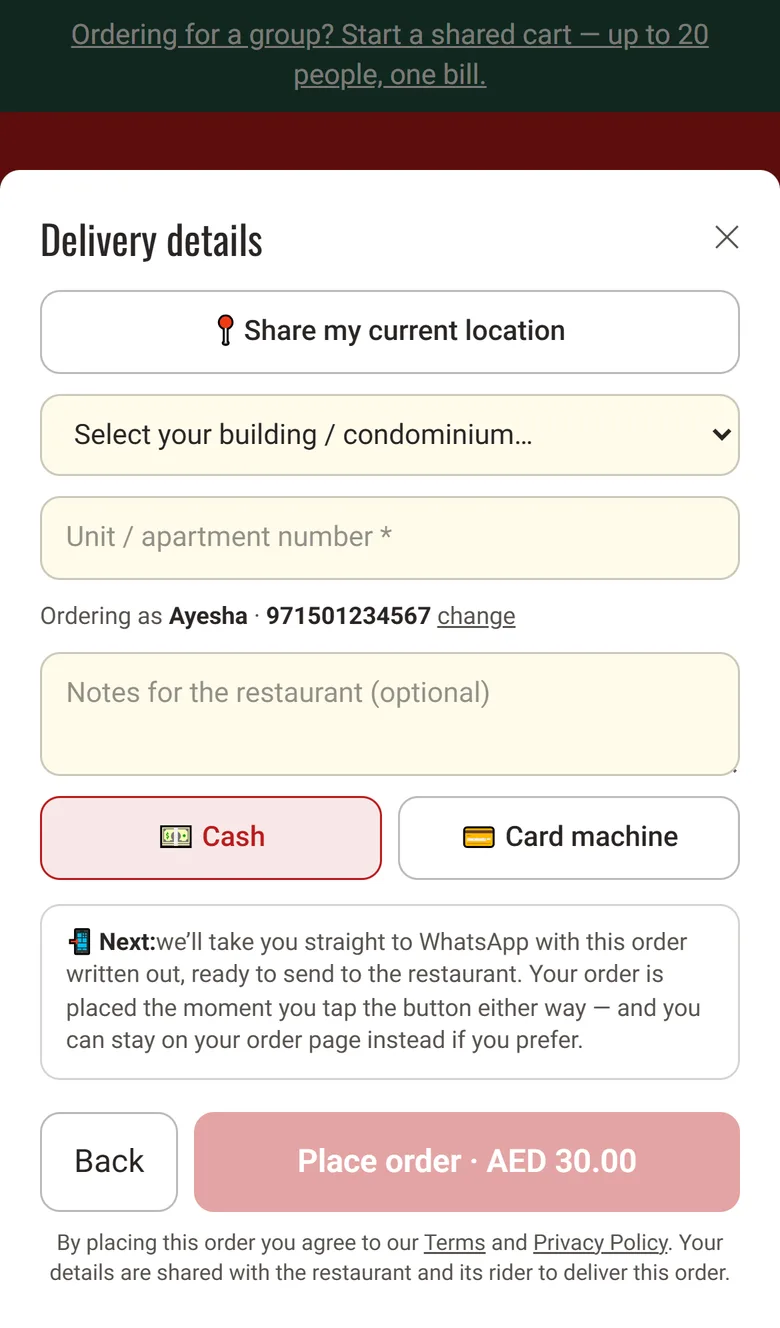
GetMenu is built around that journey. The customer orders on your own page, picks the building and unit number at checkout and can share a map pin. The moment the order is placed, your own WhatsApp number confirms it to the customer and posts the ticket in your managers' group. Your riders read the building, unit, map pin and phone in their own WhatsApp group, with a note to collect cash or bring the card machine, and close the order with one tap. There is no commission on any of it.
With the POS add-on, phone orders typed in at the counter are sent to riders the same way, and online and WhatsApp orders show on the POS screen beside counter sales. Every order prints on one kitchen ticket at each station: counter, web and WhatsApp. There is one stock list for the counter and the online menu. None left on the POS also takes the dish off the other POS devices and the online menu.
Petpooja is priced per outlet per year, and the plan is only the start. In India, one software listing shows about 12,000 rupees for the first year on the entry plan, 22,000 for Growth and 42,000 for Scale. Petpooja's own pricing page lists the restaurant website, QR ordering, the kitchen display and loyalty as add-ons. One review puts a typical first year at 35,000 to 70,000 rupees or more once those are counted. In the UAE, Petpooja's page publishes a starting yearly price per outlet in dirhams. Ask for the all-in figure for the petpooja billing software with the delivery, online ordering and inventory modules you would actually use.
GetMenu is a flat monthly plan in your currency on the pricing page, with no commission on orders. The ordering page, the WhatsApp messages, stock and invoices are included in every monthly plan, and invoices carry your tax number once you add it. Loyalty stamps and tiers for your regulars come on the Pro plan. The POS is a yearly add-on with no trial of its own; the plan's trial runs 15 days with no card. There is no long list of modules to price: you choose a plan, and add the POS if you sell at a counter.
| Petpooja POS | GetMenu | |
|---|---|---|
| Home market | India; also sold in the UAE and South Africa, with pages for Singapore and Malaysia | Any country; the restaurant sets its own currency and country |
| Counter | Billing, kitchen order tickets, inventory, payroll | POS app on iPad, iPhone and Android, paired with a six-character code; receipt and kitchen printers over USB (on the LAN), network, Bluetooth or built-in; the cash drawer opens through the receipt printer; kitchen tickets print per station |
| Delivery apps | Swiggy and Zomato in India; Talabat, Deliveroo, Careem and noon in the UAE; ask for your city | Talabat, foodpanda, Deliveroo, Careem, Keeta and GrabFood once each grants partner access; noon Food by hand |
| Direct orders | Online ordering as an add-on (pricing page) | Your own ordering page included, no commission, at yourname.getmenu.ae or your own domain as an add-on |
| Riders | Ask for a demo | A WhatsApp dispatch to your riders' group with building, unit, pin and phone, and a one-tap Delivered link |
| Customer messages | Ask for a demo | WhatsApp confirmation and status updates from your own number; on the Pro plan, a loyalty card in Apple Wallet or Google Wallet |
| Price shape | Per outlet per year, plus add-on modules; in rupees plus GST in India, in dirhams in the UAE | A flat monthly plan in your currency, with a 15-day trial and no card; the POS a yearly add-on with no trial |
Choose Petpooja if you run an Indian restaurant in India, or a brand with branches in India and the Gulf that wants the same billing system on both sides. At home the Swiggy and Zomato link brings in most of the orders. Choose it if Petpooja, or its partner, supports your city, answers the phone and has connected the local apps. Its billing is fast, its reviews are good, and for busy Indian kitchens it is a good choice.
Choose a system built for direct orders if your orders come by phone, WhatsApp and a link more than through apps. Choose it if your riders are your own people reading dispatches on WhatsApp, and if you would rather pay one flat price than price a list of modules. GetMenu is built for that. For the wider picture, see our guide to comparing restaurant POS systems.
Anzul Aqeel, the founder of GetMenu, spent a decade in POS reselling and SMS marketing before building the ordering system himself. "A system is only as good as the apps it talks to in your city. Ask for a restaurant near you that uses it, and call them first."
Run both for a week with real orders, then compare local support, delivery apps, rider dispatch and the total price.
Choose the one that also told your riders without a phone call.
A restaurant management platform from Ahmedabad, India, built around fast billing, kitchen order tickets, inventory, payroll and the Indian delivery apps. Its own site counts more than 150,000 businesses across India, the UAE and South Africa. Most of its users and most of the searches for it are in India. It entered the UAE and South Africa through local partners and now runs its own UAE support line.
In India, one software listing shows about 12,000 rupees for the first year on the entry plan, 22,000 for Growth and 42,000 for Scale, per outlet. Add-ons such as the website, QR ordering and loyalty cost extra, and one review puts a typical first year at 35,000 to 70,000 rupees or more. In the UAE, Petpooja's own page publishes a starting yearly price per outlet in dirhams. Ask for the all-in figure with the modules you would use.
Yes. Petpooja entered the UAE in 2022 with a local partner, eLine Hospitality. Its UAE page offers local support by call or email and says orders from Talabat, Deliveroo, Careem and noon land on one POS screen. Ask for a restaurant in your city that uses it, who installs and supports the hardware, and how a delivery reaches your riders. The Swiggy and Zomato integration that defines Petpooja in India does not apply here.
Reviewers call it strong for medium and large Indian restaurants with heavy delivery, and note that single-outlet owners often find the price steep once the add-on modules are counted. For a one-branch kitchen outside India, the all-in quote and the module list decide it. A flat-price system that includes ordering and messages is the alternative to compare.
Its strengths are fast billing, one of the best Swiggy and Zomato links in India and high user ratings. Its weaker points show outside India: local support depends on the country, the delivery apps connected change from city to city, and the all-in yearly price grows with each add-on module. Check all three for your own city before you sign.
For an Indian restaurant in India with high volume and Swiggy and Zomato orders, usually yes; its satisfaction ratings are high. For a restaurant outside India the answer depends on the four checks in this guide: local support, the delivery apps connected in your city, how orders reach riders, and the all-in yearly price. If two of the four come back weak, look at a system built for direct orders.
No. GetMenu's delivery-app connections are Talabat and foodpanda, Deliveroo, Careem, Keeta and GrabFood, once each app grants your restaurant partner access, with noon Food orders typed in by hand. An Indian restaurant in India that lives on Swiggy and Zomato should stay with a system that connects to them.
One that carries the whole direct order: your own ordering page with no commission, a WhatsApp confirmation to the customer and a dispatch to your riders with the building, unit and pin. GetMenu's flat plan covers that, with a 15-day trial and no card. Its yearly POS add-on, with no trial of its own, prints every order on one kitchen ticket: counter, web and WhatsApp. It runs on an iPad or Android tablet you already own.
Android lets a small restaurant run its counter on a tablet it already has, or on a machine with the printer inside. Here is which devices to buy and how to set them up.
Toast is not sold in most countries. Here is what a restaurant elsewhere should check in any system it can buy: card payments, devices and how orders reach riders.