
Kitchen display system software vs paper tickets
Orders get lost on paper because paper falls, sticks and fades. They get lost on a screen when nobody looks at it. Here is where each wins, and how one kitchen runs both.
Home / Blog / Deliverect POS or your own ordering channel: which do you need?
Deliverect moves app orders into your POS; a channel of your own moves customers off the apps. Different problems, different tools. What Deliverect does and costs, what a direct channel does, and how to decide.
Anzul Aqeel · Founder & Director, Anunzio International FZC · 7 October 2026 · updated 16 October 2026
Most small kitchens do not need Deliverect first. A Deliverect POS integration is software that sits between the delivery apps and your POS and puts all their orders in one place. It does not lower the 20 to 30% the apps charge on each order. A page of your own does. Here is when each fits.
Deliverect is middleware, which means software that sits between the delivery apps and your POS and passes their orders along. Its own site says it serves 80,000 locations with more than 1,000 integrations, and that every order from the apps lands directly in your POS. In practice the orders from Talabat, Deliveroo, Uber Eats and the rest stop arriving on separate tablets, one for each app, and start arriving in your POS, with menus and stock kept in sync across the apps. For a brand with five apps, several sites and a POS to feed, that is a real job done well.
What it does not do is change the money on each order. Deliverect's own Deliverect Direct page says plainly that every order through a third-party platform costs 20 to 30% in commission. Deliverect saves the re-typing and the missed orders, and the app keeps its share. So a Deliverect POS integration answers the question "how do I run many apps without chaos". It leaves the question "how do I stop paying 20 to 30% on my regulars" where it was. Our guide to online food delivery platforms sets out that trade in full.
Deliverect does not show a price on its pricing pages. A check of those pages by another software company found no figure, and says its terms list a setup fee, a monthly fee for each location and a fee on each order. Third-party listings show plans priced by the number of orders a month, and a price that rises with your locations, your order volume and the add-ons you choose. Ask for the all-in monthly figure, including setup and the fee on each order.
The point is what the fee buys. You pay Deliverect every month, and on every order, so that the apps' orders reach your POS more smoothly. The apps still take their commission. That is worth it when app orders are many and the chaos is real. It is a strange bill for a kitchen whose app orders are a minority and whose regulars would order direct if asked.
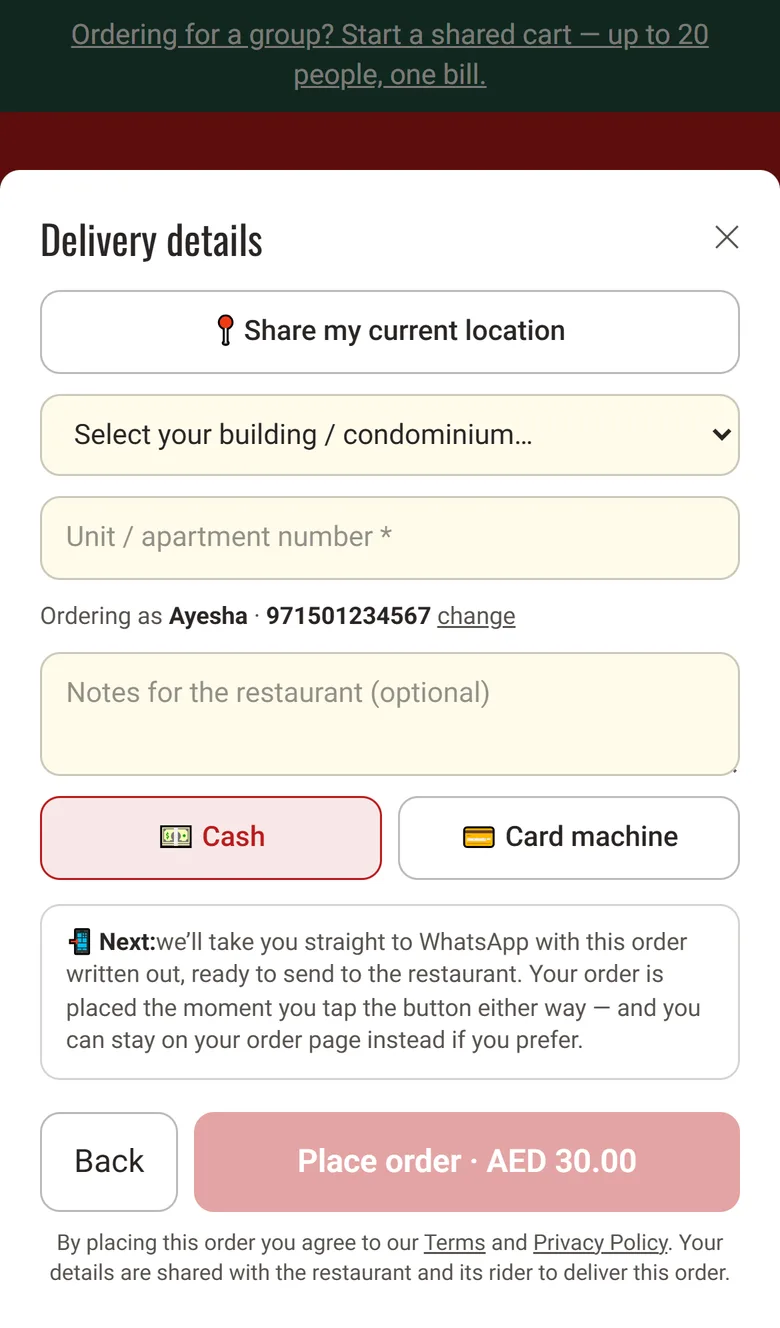
An own ordering channel is a page at your restaurant's web address where the customer orders without an app. The order then reaches the kitchen and the rider. On GetMenu, your own ordering page takes a name and number before checkout. At checkout the customer picks their building from your list, types the unit number and can share a map pin. The customer pays cash or by card machine when the food arrives. The moment the order is placed, the customer, your managers and your riders each get a WhatsApp message from your own number; the riders' copy holds the address, the pin and whether to collect cash or bring the card machine. There is no commission, and the customer's number is yours.
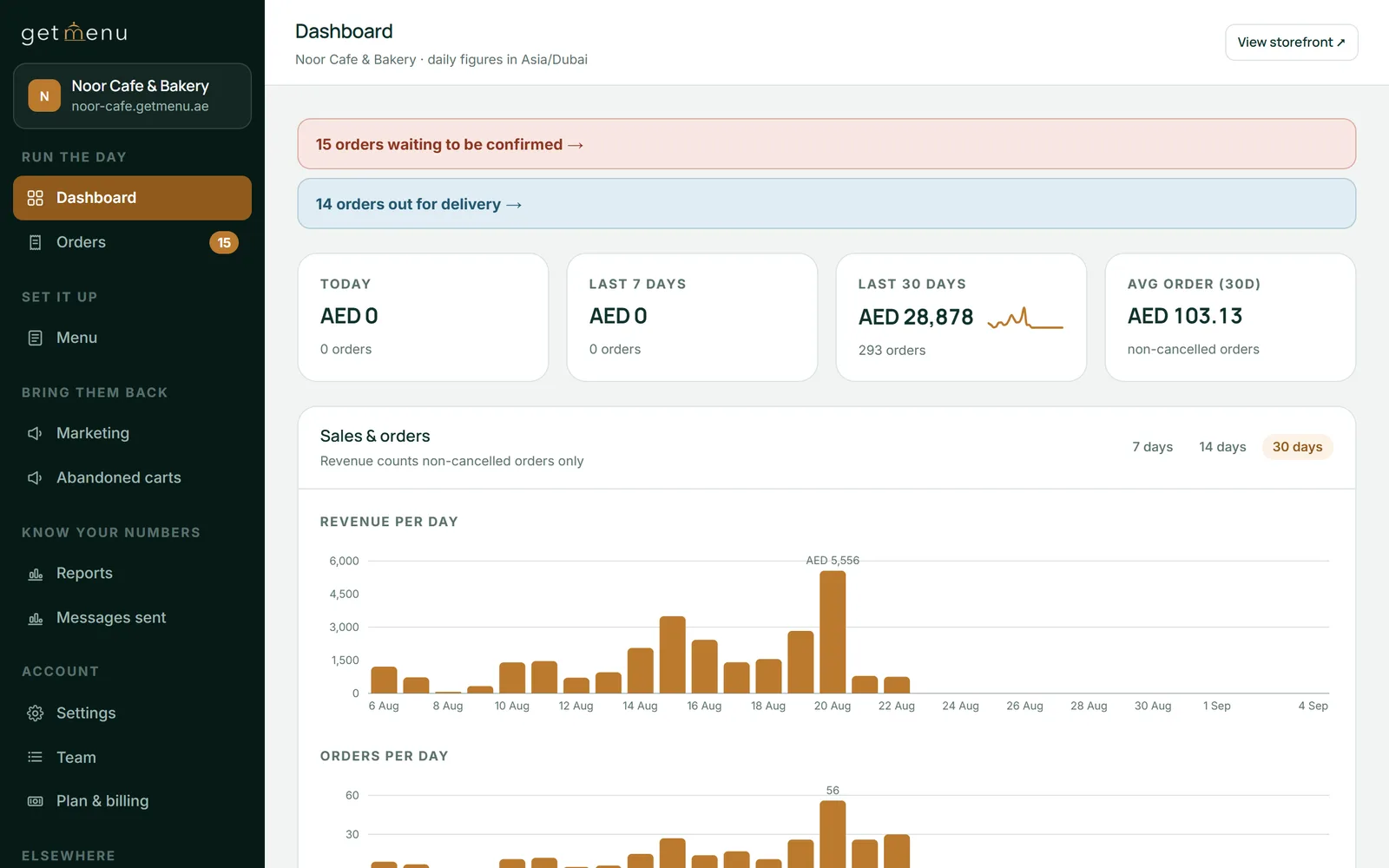
GetMenu also does part of Deliverect's job, built in. Once each app grants your restaurant partner access, orders from Talabat, foodpanda, Deliveroo, Careem, Keeta and GrabFood land on the same orders board as your own, and on the kitchen screen with the POS add-on. Noon Food orders are typed in by hand. Marking a dish sold out tells the connected apps for matched dishes. It is six apps on one board, not a thousand integrations.
GetMenu has its own POS too, a yearly add-on with no trial of its own. The POS app runs on iPad and iPhone from the App Store, and on Android tablets and phones. Online and WhatsApp orders show on the POS screen beside counter sales. Every order goes on one kitchen ticket, counter, web and WhatsApp, printed for each station. There is one stock list for the counter and the online menu: mark a dish None left at the POS and it is sold out on the other POS devices and on the online menu at once. That is why a small kitchen with its own POS rarely needs middleware.
Deliverect Direct is Deliverect's own tool for taking orders on your own website. Deliverect sells it beside its main product, to control your brand, pricing and customer data. So Deliverect also sees a channel of your own as the long-term fix for commission. The difference from GetMenu is where the channel starts. Deliverect Direct is an add-on to a platform built around apps and a POS. GetMenu is a channel built around WhatsApp, cash on delivery and your own riders, with the delivery apps brought in beside it.
Choose Deliverect if you run several sites, take orders from four or more apps and have a POS the apps must feed. Choose a channel of your own first if you run one kitchen and your riders are your own. In that kitchen, orders come by phone, WhatsApp and a link as much as through apps, and the six-app board may be all the middleware you ever need. If you are a delivery brand with many app orders and you want to move the regulars off the apps, you may need both: middleware for the app orders, a channel for the second order.
If you can only do one thing this month, put your page link in every app bag.
An app order gives up 20 to 30% of its value to the app before you see it, and middleware adds its own fee on top. On a monthly plan, an order from your own page gives up nothing per order. The cost is the flat monthly plan, the same whether you take fifty orders or five hundred.
Now look at this month's app orders. How many came from people who already know you? Those customers would order from your page if you sent them the link on WhatsApp. You paid the app 20 to 30% for each of those orders.
GetMenu's plans are a flat monthly price in your currency on the pricing page, with no commission and no online payment to process. The ordering page, the WhatsApp messages, the six-app board and stock are in every plan, invoices are in every monthly plan, and loyalty is on the Pro plan. The trial runs 15 days with no card, and the POS is a yearly add-on with no trial of its own.
| Deliverect | GetMenu | |
|---|---|---|
| What it is | Middleware joining delivery apps to a POS, plus Deliverect Direct as a direct channel | A direct ordering channel with WhatsApp dispatch, plus six delivery apps on the same board |
| Apps covered | The major delivery apps, within more than 1,000 integrations of every kind (POS, apps, loyalty, payments), by its own count | Talabat, foodpanda, Deliveroo, Careem, Keeta, GrabFood with partner access; noon Food by hand |
| Commission on app orders | Unchanged: the apps' 20 to 30% | Unchanged on app orders; none on orders from your own page |
| The customer's number | Stays with the app on app orders; yours on Deliverect Direct orders | Yours, with the WhatsApp confirmation from your own number |
| Riders | The apps' couriers, or Deliverect's Dispatch and Courier App add-ons for delivery partners and your own drivers | A WhatsApp dispatch to your own riders with building, unit, the map pin when shared, and a Delivered link |
| Payments | Through the apps and your POS, and online through a payment provider on Deliverect Direct | Cash or your own card machine on delivery; no online payment |
| Price shape | A setup fee, a monthly fee for each location and a fee on each order, by quote | A flat monthly plan in your currency with a 15-day trial, no card; the POS a yearly add-on with no trial of its own |
Put a QR card with the link to your page in every app bag, with a first-order reason to use it (a first-order coupon on the Growth and Pro plans). Put the link in your WhatsApp greeting and your Instagram bio. Upload the whole menu from a spreadsheet instead of typing it, so the page is live this week. Link your WhatsApp number, pick the managers' and riders' groups, and import the building list with a fee per building. Each app order is labelled on the orders board, so count each week how many came through the apps and how many through your own page. On the Pro plan, regulars grow into tiers with their own discounts and the loyalty card keeps updating itself in Apple Wallet or Google Wallet, so the second direct order is easier than the first.
Anzul Aqeel, the founder of GetMenu, spent a decade in POS reselling and SMS marketing before building the ordering system himself. "Middleware puts all the app orders on one screen. A channel of your own means fewer orders come from apps at all. Build the channel first."
It is middleware, software that connects the delivery apps to your POS so their orders arrive in one place without re-typing. It also keeps menus and stock in sync across the apps. Its own site counts 80,000 locations served and more than 1,000 integrations. It does not change the commission the apps charge on those orders, which Deliverect's own Deliverect Direct page puts at 20 to 30%.
Deliverect does not publish a price. Its terms describe a setup fee, a monthly fee for each location and a fee on each order, agreed by quote. Third-party listings show the price rising with the number of orders a month, your locations and the add-ons you choose. Ask for the all-in monthly figure, including setup and the fee on each order, before you sign.
An aggregator is a tool that collects orders from many apps in one place. If you run several sites, four or more apps, and a POS the apps must feed, you probably need one. If you run one kitchen with few app orders and your own riders, you probably do not: a direct channel with the main apps on one board covers it. First ask how many app orders could be direct orders.
It is Deliverect's own tool for taking orders on your own website, sold beside its main product so a brand can keep its customer data. It shows that Deliverect also sees a channel of your own as the long-term fix for commission. The difference with GetMenu is the starting point: an add-on to an app platform, against a channel built around WhatsApp, cash on delivery and your own riders.
Yes, for six apps. Once Talabat, foodpanda, Deliveroo, Careem, Keeta or GrabFood grants your restaurant partner access, its orders land on the same orders board as your own, and on the kitchen screen with the POS add-on. Noon Food orders are typed in by hand. Connecting the apps works on any plan. It is six apps on one board, not a thousand integrations.
There is no integration between them, so an order would not flow from one to the other. A kitchen that needs Deliverect for many apps and sites would run it into its POS. It could still run GetMenu as its own ordering channel with WhatsApp dispatch beside it, as two systems. Most small kitchens will not need both; the six-app board and the channel cover the day.
Orders get lost on paper because paper falls, sticks and fades. They get lost on a screen when nobody looks at it. Here is where each wins, and how one kitchen runs both.
Most small kitchens do not need to weigh the oil. They need the biryani to show as sold out the moment the last portion goes. Here is the difference, and where to start.